-
Science and research
- ⋅
- 11/06/2026
- ⋅
- Reading time approx. 2 min
Pełen diagram fazowy domieszkowanego fluorem nadprzewodnika PrFeAsO1-xFx, 0 ≤ x ≤ 1
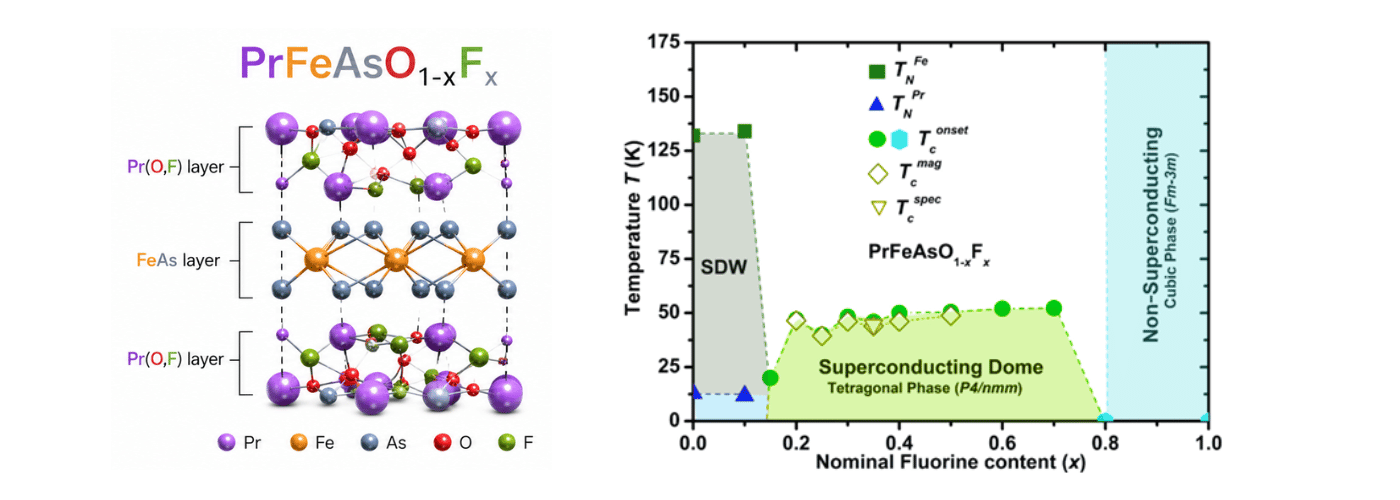
Prof. Shiv J. Singh’s research team (Laboratory of Superconductors and Hydrogen Technologies, NL-6) has successfully established the first complete electronic phase diagram of fluorine-doped PrFeAsO (Pr1111: PrFeAsO1-xFx), covering the full doping range up to 100% fluorine substitution (0 ≤ x ≤ 1). This represents a major step forward in understanding iron-based oxypnictide superconductors.
The study reports a systematic investigation of PrFeAsO1-xFx across the entire nominal fluorine range, revealing a broad dome-shaped superconducting phase emerging from the non-superconducting parent compound. Structural analysis shows a continuous lattice contraction with increasing fluorine content, supported by Raman spectroscopy and density functional theory (DFT) calculations, which indicate softening of the Pr(A1g) phonon mode and hardening of the Fe(B1g) mode. These results confirm effective fluorine incorporation at oxygen sites and its strong influence on lattice dynamics.
The superconducting transition temperature (Tc) reaches up to 52.3 K, approximately 5 K higher than previously reported values for the Pr1111 system. Magnetotransport measurements reveal exceptionally high upper critical fields exceeding 100 T and complex vortex dynamics, including a crossover from single-vortex to collective pinning regimes. Specific heat measurements show a reduced jump, suggesting strong superconducting fluctuations and multiband pairing behaviour. Overall, this work establishes clear structure–property correlations and provides a unified description of superconductivity across the full doping range of PrFeAsO1-xFx.
For more details, please refer to the publication: Priya Singh, Konrad Kwatek, Tatiana Zajarniuk, Taras Palasyuk, Cezariusz Jastrzebski, Andrzej Szewczyk, and Shiv J. Singh entitled “Electronic phase diagram and enhanced superconductivity in fluorine-doped PrFeAsO1-xFx” Journal of Alloys and Compounds 1072, 188942 (2026) (Impact factor: 6.2) https://doi.org/10.1016/j.jall...
Full text access of the article is avaialable 50 days from the publication under this link: https://authors.elsevier.com/a...
Latest