-
Science and research
- ⋅
- 07/07/2026
- ⋅
- Reading time approx. 2 min
Izowartościowe podstawienie antymonu (Sb) w miejsce arsenu (As) jako sposób kontroli nadprzewodnictwa w żelazowych oksypniktydach
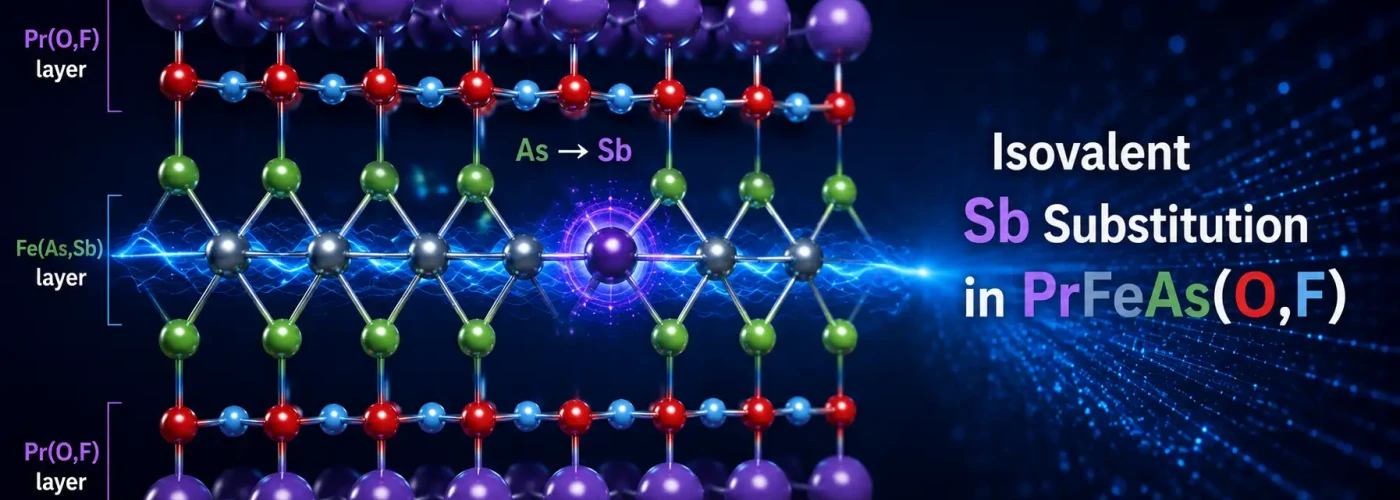
Among the various approaches for tailoring superconducting properties, isovalent substitution has emerged as a powerful strategy for modifying the electronic structure without introducing additional charge carriers. In a recent study, Prof. Shiv J. Singh's research group at the Laboratory of Superconductors and Hydrogen Technologies (NL-6) investigated how isovalent antimony (Sb) substitution at the As site influences the structural, electronic, and superconducting properties of the iron-based oxypnictide superconductor PrFeAs(O,F) (Pr1111).
By combining structural characterization, Raman spectroscopy, electrical transport, magnetotransport, magnetic measurements, and density functional theory (DFT) calculations, the researchers demonstrated a crossover from an electronically tuned regime at low Sb concentrations to a disorder-dominated regime at higher Sb substitution levels. At low Sb content, superconductivity remains remarkably robust, exhibiting only a slight reduction in the superconducting transition temperature together with enhanced vortex pinning and improved superconducting homogeneity. Raman spectroscopy and DFT calculations further reveal subtle modifications of the Fe–pnictogen bonding environment while preserving the essential electronic structure responsible for superconductivity.
With increasing Sb concentration, structural disorder and the formation of secondary phases become more pronounced, leading to enhanced carrier scattering, degradation of intergranular connectivity, and rapid suppression of superconductivity. The study establishes clear correlations between lattice expansion, phonon softening, structural disorder, vortex dynamics, and superconducting properties, providing a unified framework for understanding how isovalent substitution influences superconductivity in 1111 iron-based oxypnictides. These findings provide valuable insights into the interplay between crystal structure, chemical substitution, and superconductivity, offering new perspectives for the design and optimization of advanced iron-based superconducting materials.
The results have been published in:
Priya Singh, Konrad Kwatek, Tatiana Zajarniuk, Taras Palasyuk, Cezariusz Jastrzębski, Andrzej Szewczyk, Michał Wierzbicki, and Shiv J. Singh, “Tuning Superconductivity by Isovalent Antimony Substitution in PrFeAs(O,F)”, Physica B: Condensed Matter 740, 419025 (2026) DOI: 10.1016/j.physb.2026.419025.
Latest