-
Science and research
- ⋅
- 01/06/2026
- ⋅
- Reading time approx. 2 min
Obliczenia potwierdzają ograniczoną dyfuzję krzemu w GaN
Ion implantation has been widely used in the semiconductor industry for decades as a precise method of introducing dopants into materials. Today, this technology is attracting increasing interest in gallium nitride (GaN), a material of key importance for modern power electronics and optoelectronics. One of the major challenges associated with ion implantation is the damage introduced into the crystal lattice during the implantation process. Removing this damage requires high-temperature annealing, which is particularly challenging in GaN due to its tendency to decompose at elevated temperatures. This issue can be overcome by ultra-high-pressure nitrogen annealing (UHPA), which enables both lattice recovery and dopant activation while preventing GaN decomposition.
In a recently published study, researchers combined density functional theory (DFT) calculations with experimental investigations using X-ray diffraction (XRD) and secondary ion mass spectrometry (SIMS) to examine silicon-doped GaN. Silicon ion implantation followed by ultra-high-pressure annealing (UHPA) at 1450°C under 1 GPa of nitrogen pressure resulted in a successful reconstruction of the crystal lattice, as confirmed by XRD measurements. SIMS analysis revealed only negligible diffusion of silicon, even under these extreme processing conditions. This finding is particularly interesting when compared with magnesium, for which significantly higher mobility and pronounced dopant redistribution have been observed under similar UHPA conditions.
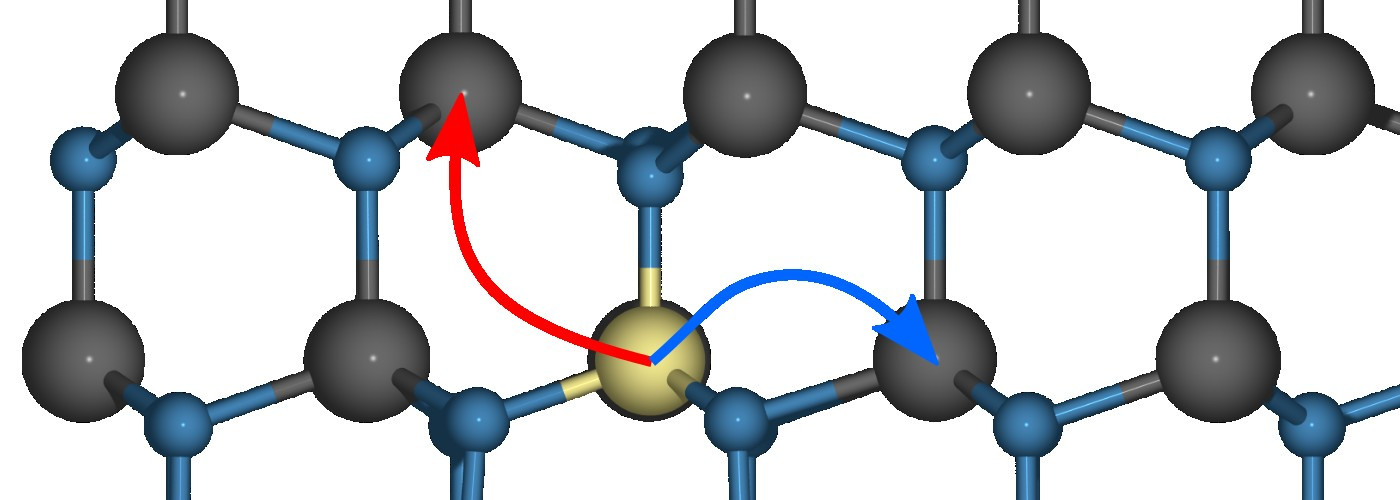
The observed stability of silicon is supported by DFT calculations, which also revealed a strong anisotropy of its diffusion. The lowest migration barrier, approximately 3.2 eV, was found along the [11-20] crystallographic direction, whereas the highest barrier, reaching 9.9 eV, was obtained for the [1-100] direction, making diffusion along this path highly unlikely. Furthermore, phonon calculations showed that temperature-induced reductions in the effective diffusion barriers are minimal, explaining the remarkable stability of silicon doping profiles observed experimentally in GaN.
These results confirm the high stability of silicon-doped regions in GaN and provide valuable insight for the design of reliable next-generation electronic and optoelectronic devices.
More information can be found in the article: Limited diffusion of silicon in GaN: A DFT study supported by experimental evidence, Karol Kawka, Paweł Kempisty, Akira Kusaba, Krzysztof Golyga, Karol Pożyczka, Michał Fijałkowski oraz Michał Boćkowski. https://doi.org/10.1063/5.0325...
Latest