-
Science and research
- ⋅
- 03/07/2026
- ⋅
- Reading time approx. 4 min
Zastosowanie powietrza jako warstwy okładkowej otwiera nowe perspektywy dla konstrukcji laserów o dłuższych falach: zielonych, żółtych, czerwonych
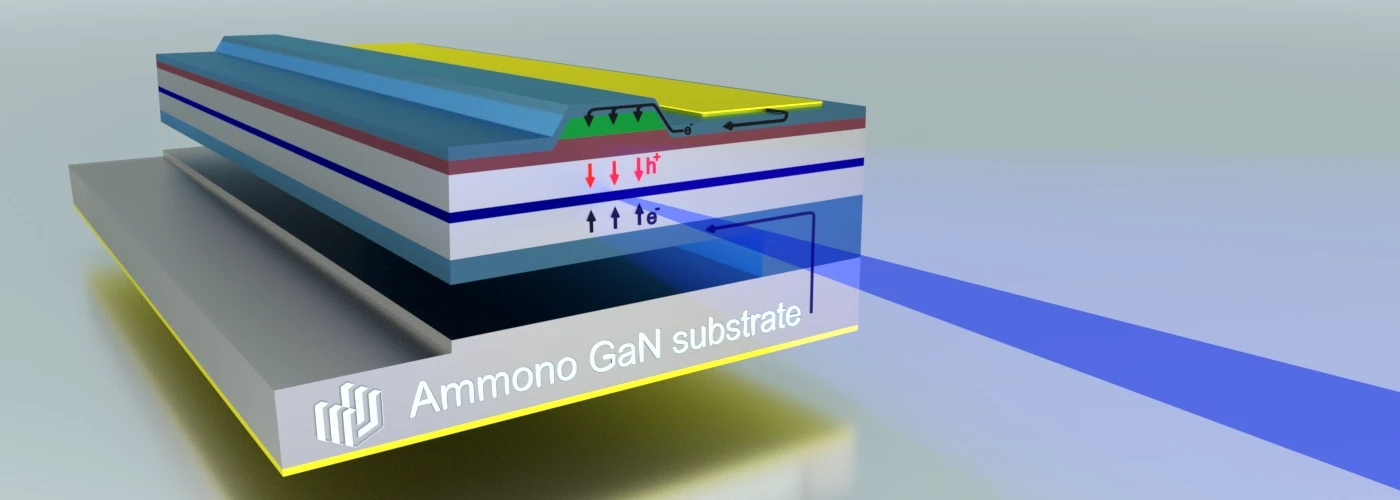
Laser diodes made from gallium nitride (GaN) can be found in many everyday applications: laser projectors, Blu-ray players, medical devices, car headlights and fiber-optic communication. They shine brightest in the blue while fabrication of longer wavelength - green, yellow, and red – becomes more and more challenging because of the increasing amount of indium that needs to be added to the active region. Apart from difficulties in preserving structure quality of such semiconductor crystal, a key bottleneck is optical confinement: keeping the light tightly guided inside the laser's active region. Traditionally, this is done by sandwiching the active layer between cladding layers made of material of much lower refractive index. The lower refractive index of the cladding, the better, but due to the technology limitations aluminum gallium nitride (AlGaN) crystal layers are used providing tolerable optical confinement. But as you push toward longer wavelengths, these claddings become increasingly strained, thick, and difficult to grow without cracking.
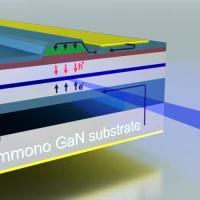
Now, researchers from our Institute have demonstrated a radically different approach: replacing both cladding layers with nothing at all - just air. In a newly published, open-access study in ACS Applied Materials & Interfaces, the team reports the first electrically driven edge-emitting nitride laser diodes featuring air claddings from both sides of the active region. Since air has the lowest possible refractive index (n = 1), it can provide the maximum possible contrast with the GaN-based waveguide, ensuring excellent light confinement without any strained AlGaN layers.
How do you build a laser that “floats” in the air? Two clever tricks make it possible.
On the top side, a tunnel junction is added that is a nanoscale structure that converts hole current into electron current. This allows the electrical contact to be placed on the side of the laser ridge rather than on top, leaving the upper surface completely metal-free and exposed to air.
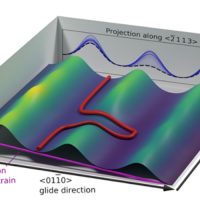
On the bottom side, the researchers grow a thin sacrificial layer of heavily germanium-doped InGaN beneath the laser structure. After fabrication, they use lateral electrochemical etching (ECE) to selectively dissolve this sacrificial layer through tiny access openings, leaving the entire laser membrane suspended over an air gap. Depending on the geometry of these openings, the resulting devices take on either a "wing-like" or a "membrane" shape. Synchrotron X-ray measurements carried out in collaboration with German and French researchers reveal only a few nanometers of bending across the entire structure. Remarkably, the underside of the released membrane is atomically smooth. This, in turn, was made possible by molecular beam epitaxy (MBE) technology, which enables the atomic-scale precision fabrication of successive semiconductor crystal layers differing in germanium doping levels by several orders of magnitude.
The proof-of-concept devices lased at a wavelength of 456 nm (blue) in pulsed mode with a slope efficiency of 0.4 W/A - matching or even outperforming reference lasers with conventional GaN claddings.
But the real promise lies beyond blue. Simulations show that the air-cladding architecture delivers much greater improvements in optical confinement for green, yellow and red emitters, exactly where conventional AlGaN claddings struggle the most. This could finally unlock efficient, electrically driven nitride lasers across the entire visible spectrum.
Beyond wavelength engineering, the electrochemical liftoff technique opens a door to transferring nitride lasers onto arbitrary platforms e.g. silicon photonic chips, flexible substrates, or even implantable biomedical devices for optogenetics and therapy. And if the process is scaled to full wafers, the expensive GaN substrates can be reused, significantly cutting manufacturing costs.
More details can be found directly in the publication: M. Sawicka, M. Hajdel, O. Gołyga, H. Turski, M. Chlipała, A. Feduniewicz, S. Stańczyk, C. Skierbiszewski, C. Corley-Wiciak, C. Richter, and G. Muziol, Air-Cladding Blue Laser Diodes, ACS Applied Materials & Interfaces 18, 35483 (2026). https://doi.org/10.1021/acsami...
Latest