| Title: | Optical gas sensor based on the rare earth doped nano-ZrO2 |
| Project leader: | Witold Łojkowski |
| Laboratory: | Laboratory of Nanostructures (NL-4) |
| Call/Programme name: | Bilateral mobility projects for 2024–2025 |
| Project number: | QTPL01.01/24-25 |
| Implementation date: | 01.01.2025 30.12.2026 |
| Implementing entity: | Institute of High Pressure Physics PAS (IHPP PAS), Laboratory of Nanostructures in Warsaw, Institute of Materials Science VAST (IMS VAST), Laboratory of Photochemistry, Imaging and Photonics in Hanoi |
| Funding institution: | International Cooperation Department of the Polish Academy of Sciences (BWZ PAN) |
Project description
Cooperation between the research teams of both Laboratories has been ongoing for over a decade. The Polish team has extensive experience in the synthesis, characterization, and application of a wide range of nanoparticles. The Laboratory of Nanostructures at IHPP PAS is equipped with high-end instrumentation dedicated to nanotechnology. The Vietnamese partner specializes in research on metal-organic nanomaterials exhibiting photoluminescent properties.
The aim of the Project is to combine the unique competencies of both teams in the field of optical nanomaterials intended for gas sensor applications. The expected outcome of the work is the development of synthesis parameters for zirconium-based nanopowders, primarily Zr-MOF:RE³⁺ metal-organic frameworks, which will enable highly sensitive detection of oxygen concentration changes in a gaseous environment.
An essential aspect of implementing this mobility project is the direct collaboration of scientists and gaining insight into the specific workflows of the partner laboratories. Thanks to the funding received, personnel exchanges between members of both teams are possible, allowing a significant portion of the research work to be carried out directly at the partner's facilities.
Project Tasks
- Synthesis and characterization: Production and measurement of the morphological parameters and optical properties of Zr-MOF:RE³⁺ nanoparticles doped with various rare-earth elements (e.g., Eu, Tb). This work will be carried out in the laboratories of both partners.
- Analysis of sensing properties: Investigation of the influence of dopant type and concentration on photoluminescence kinetics in various gas atmospheres. The results will allow the selection of optimal nanopowders for use as an oxygen sensor. This work will be conducted at the Laboratory of Nanostructures, IHPP PAS.
- Modelling: Proposing a physical model of the optical oxygen sensor, as well as discussing and describing the mechanisms responsible for the sensing effect.
- Dissemination activities: During mutual study visits, scientific seminars and discussions on the results will be organized, and manuscripts will be prepared for publication in renowned international journals.
Key results
Visit of the Vietnamese partner to the Laboratory of Nanostructures
From October 13 to 31, 2025, we hosted Dr. Lam Thi Kieu Giang. During intensive laboratory work, fifteen variants of metal-organic nanopowders containing rare-earth ions (Zr-MOF:Eu³⁺, Tb³⁺) were jointly synthesized. The obtained nanopowders were structurally and morphologically characterized.
Visit of the Polish partner to the Laboratory of Photochemistry, Imaging and Photonics
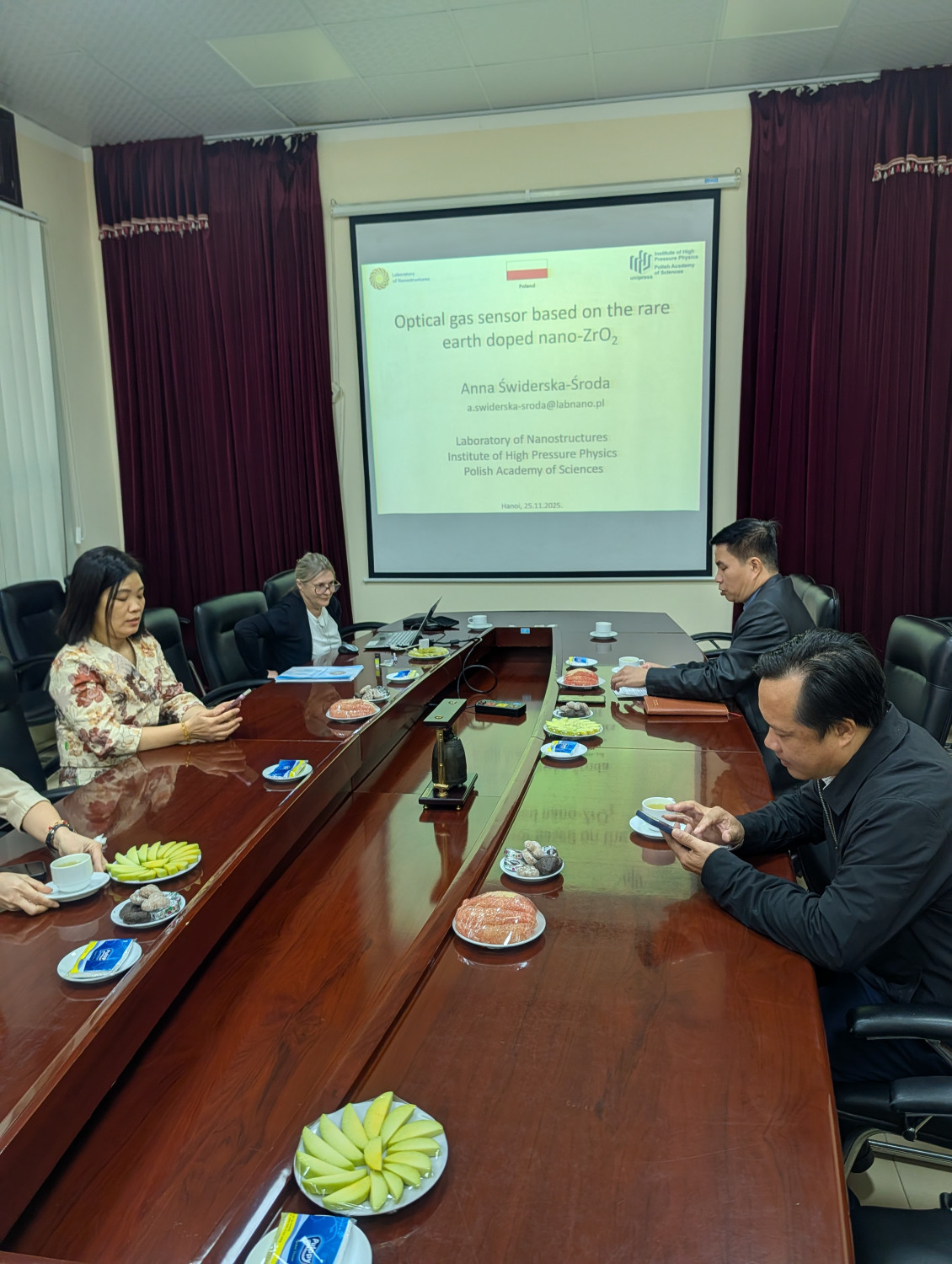
A representative of the Polish team, Dr. Anna Świderska-Środa, completed a study visit to the Vietnamese partner's laboratory (November 19–28, 2025). During the visit, she delivered a scientific seminar entitled "Optical gas sensor based on the rare earth doped nano-ZrO2". The seminar was attended by the Deputy Director of the Institute, Prof. Tran Quoc, members of the Laboratory of Photochemistry, Imaging and Photonics, as well as heads and staff of other laboratories. During the visit, the scope and schedule of further work to be carried out within the Project were discussed. The partners also explored potential areas for new collaborative topics.