-
Science and research
- ⋅
- 29/10/2026
- ⋅
- Reading time approx. 3 min
Nowe spojrzenie na mechanizm topnienia: krytyczne własności przedtopnieniowe stałego nonanolu – publikacja w J. Phys. Chem. Lett.
Discontinuous phase transitions, with melting as the canonical example, remain a theoretical challenge despite over a century of research. Modeling of this phenomenon still relies predominantly on the classical Clausius-Clapeyron (1873) and Lindemann (1910) relations. As de With summarized in a recent review (Chem. Rev. 2023): „it may well be that a generally applicable mechanistic theory, in view of the many aspects that require attention, does not exist."
One possible source of this impasse is the lack of unambiguous experimental evidence for pre-transition effects, i.e., anomalies in physical properties that emerge before the transition temperature is reached. It was precisely the identification of such effects that underlay the success of the physics of critical phenomena, which provides a consistent description of continuous phase transitions (transformations without a discontinuous change of properties).
The most recent publication by researchers from our institute addresses this issue:
A. Drozd-Rzoska, S.J. Rzoska, A. Szpakiewicz-Szatan, Critical view on dielectric constant changes in solid and liquid nonanol, J. Phys. Chem. Lett. (2026); https://doi.org/10.1021/acs.jp...
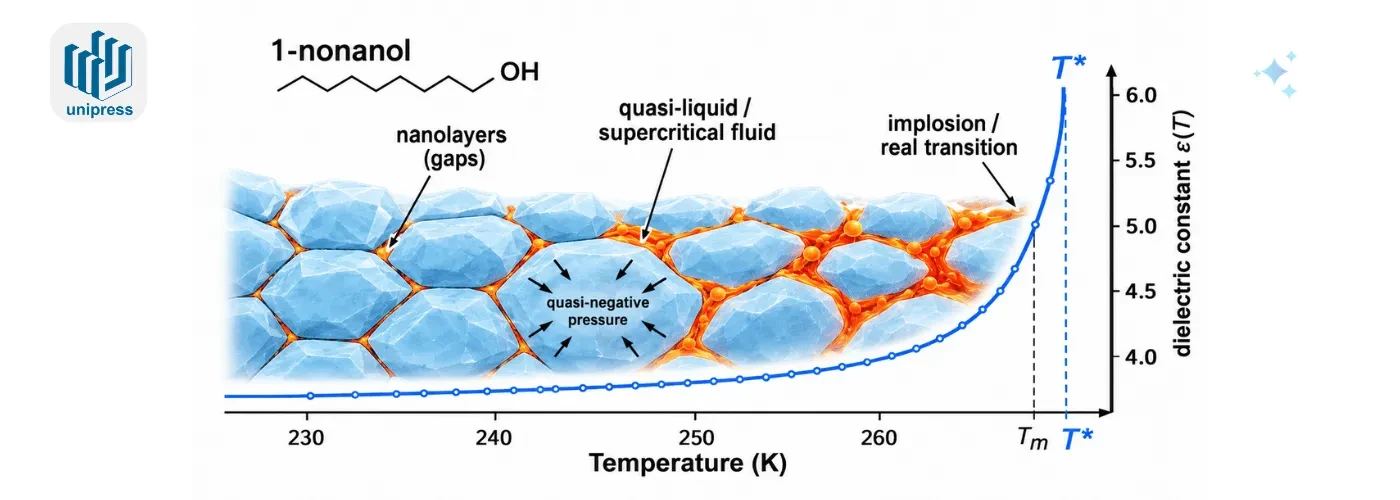
For nonanol (an alcohol with a straight nine-carbon chain, used here as a model system), the authors document a pronounced pre-melting effect in the solid phase: the dielectric constant ε (a measure of a material's ability to polarize in an electric field) follows critical-like scaling over a range extending up to 40 K below the melting temperature Tm:
ε(T) ∝ 1/(T* − T), with T* ≈ Tm + 0.4 K, for T < Tm
The authors interpret this dependence as evidence for the significant role of thin layers with liquid-like properties (so-called quasi-liquids) located between crystalline micro-grains. Notably, the dielectric susceptibility χ = ε − 1 (a quantity directly coupled to the order parameter, which characterizes the degree of order in the system) exhibits features of the so-called „Mossotti catastrophe" – a theoretically predicted situation, hitherto unobserved in systems of this kind, in which polarization grows without bounds.
In the proposed interpretation, the critical behavior of quasi-liquid nanolayers resembles that of supercritical fluids (SCFs – substances in a state intermediate between liquid and gas, known, among others, for their exceptional solvation capabilities). As the temperature approaches T*, the degree of crystal granulation and the fraction of nanolayers increase, leading to a quasi-negative pressure (tensile stress) that grows in a critical manner. However, before the system could reach the singularity at T*, the structure loses its stability at the melting temperature Tm < T*, resulting in a discontinuous transition to the liquid phase.
The proposed picture, which combines the features of discontinuous and continuous (critical) phase transitions within a single description, offers a new approach to the mechanism of melting and may serve as a starting point for further experimental and theoretical studies.
We encourage you to read the full article (Open Access):
Aleksandra Drozd-Rzoska, Sylwester J. Rzoska, Aleksander Szpakiewicz-Szatan; Critical View on Dielectric Constant Changes in Solid and Liquid Nonanol. J. Phys. Chem. Lett. 2026; https://doi.org/10.1021/acs.jp...
Latest